
Self-Publishing Under Fascism
Text by Lou Blumberg with Marc Fischer
“The physical object is what facilitates the sorts of in person experiences that I like to have. There's little reason to travel to events and book fairs if everything is purely digital. Books create physical, social spaces, including bookstores and libraries.” — Marc Fisher
One of the biggest takeaways I’m leaving art school with is: just make. Take your small fascinations and run. That’s enough. I see this ethic clearly in the work of Marc Fischer, who embraces the political (like turning the practice of court-watching into a residency with other artists who share a meal together and then create publications about their experiences) and the mundane (such as his “Morning Walks” series that turn neighborhood walks into spaces of inquiry and delight). For my final interview as a graduate student, I hoped to give myself a kick out of the door by speaking with Marc. I think it worked! I also got to meet his very cute dog.
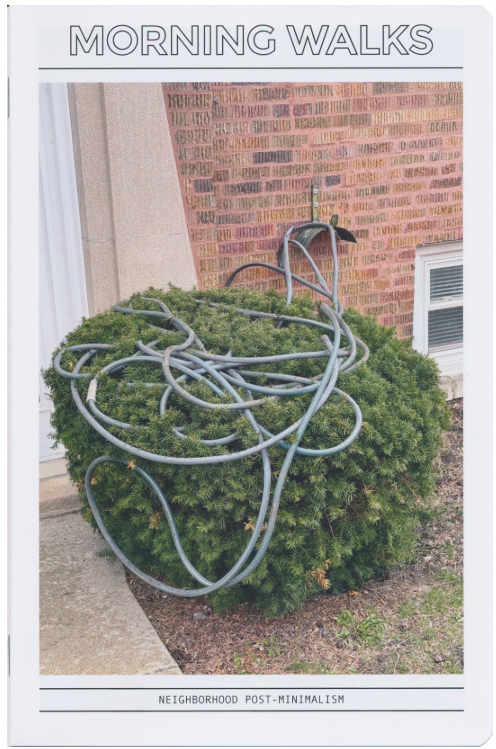
A cover of one of Marc’s “Morning Walks” publications. Courtesy of Marc Fischer.
Lou Blumberg: I was introduced to you through Against Competition and then saw your other publications, which are so many! Why has that become the medium that you're drawn to, you think?
Marc Fisher: I published zines when I was in high school and college, which were mostly underground music focused. In the time when I started doing that, most of the zines I knew were about hardcore and speed metal and stuff like that. Back then you had to actually describe what things sound like to people and you don't have to do that anymore. People can go to Bandcamp or YouTube or whatever and hear everything. Of course it's still pleasurable to read people's interviews with musicians and I conducted interviews too. Back then, music zines came out of the idea that if you're not a musician, you're not a DJ, and you're not booking shows, the way that you would support your underground music community was through publishing or writing for other people's zines.
So I did that until about maybe 1991. Temporary Services, the group I'm part of, started in 1998. Temporary Services continues as just Brett Bloom and myself. For a lot of our history, we were more people. We were three people for a long time, but now it's the two of us and then whoever we collaborate with beyond that.
Temporary Services always made publications, at first as more like exhibition guides or guides to the projects we did. The publications were a way of writing our own history and articulating our ideas and concerns as we went, and not expecting that other people would do this for us, if we didn't do it ourselves. And frequently, if someone did want to write about the work, we did all the heavy lifting for them because they could just draw on whatever we wrote. Unfortunately, a lot of art writing is lazy, and those booklets helped people describe our work more accurately.
Pretty quickly, the kinds of publications we made started to be things that were more standalone publications. We've realized, you do an event or an exhibit that is up for a day or a week or a month or something, and then you have these publications that aren't necessarily so useful beyond being a freebie for a project that someone went to for an afternoon. So we reconceived them a little so they could work more effectively as standalone, printed things, and tell the story of a project, or just exist without an accompanying exhibit.
A lot of times we would be invited to be in an exhibit and if there was any kind of budget we would make a free publication to go with our project, because otherwise the only thing that's usually printed is a group exhibit brochure that has like a paragraph about what you did and isn't very useful beyond the exhibit.
Then we started making booklets and books with other authors. By 2008 we'd been publishing long enough and starting to sell things we made so we had to deal with business realities, which we had neglected when we were just giving everything away. We didn't want to designate Temporary Services as a business. We also didn't want to be a not-for-profit, so we created Half Letter Press as an LLC, and then that became a way of dealing with the group’s money.
Lou: Something that many collectives struggle with!
Marc: Yeah, it's worked well. We have a shared bank account so that we're not using our personal money. If we want to travel for something that's not funded, then we use our business account for it. And if we have to buy supplies or mail things, which I do constantly.
I started Public Collectors in 2007. And for a while, I didn't make that many publications with Public Collectors. I was doing a lot more web based content and collection sharing events. But then gradually that morphed into making tons of publications also, because I just hate web building stuff. My website reflects that.
With publishing you create your own structure and momentum and deadlines. Temporary Services would travel for exhibits and spend all our time for a few days installing something and then you have this reception where you talk to lots of people for two or three hours, and then you go away and your work does its thing usually to far fewer people, unless it's in some kind of a museum. Places like university galleries tend to have very limited attendance after the opening, and the opening is always the worst time to actually look at and think about the work.
With book fairs you spend 45 minutes setting up and then you spend 14 hours, over two days or 20 hours if it's several days, doing nothing but talking to people and meeting people who may or may not be somewhat aware of your work, or in some cases are extremely aware of your work. And then, if they acquire your publications, they take them home and the work has a whole new life. It isn't just shipped back to you for you to figure out what else to do with it, if you're making more object-oriented things for exhibits.
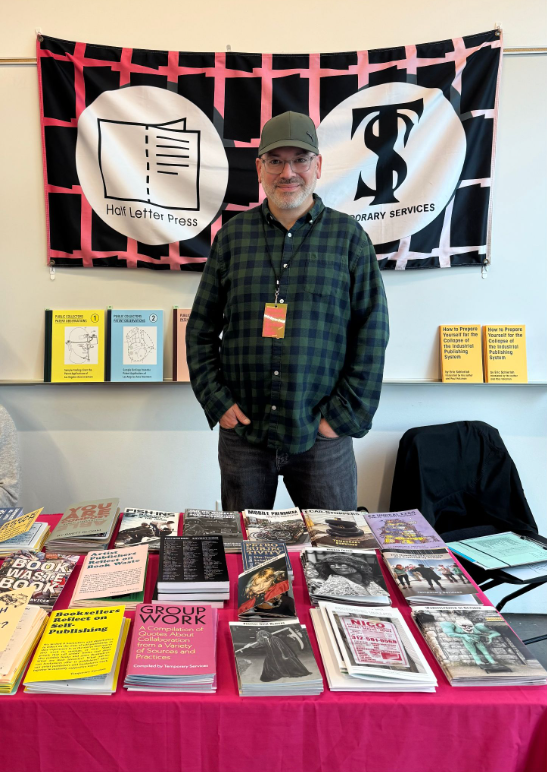
Marc’s set up at a bookfair showing an assortment of publications from Half Letter Press and Temporary Services. Photo courtesy of Marc Fischer.
Book fairs and events are socially exhausting because I'm not a super extroverted person. I'm really depleted by those kinds of events. But it's also very rewarding in terms of connecting with other people who are working in similar ways. You might not see every publisher at every event, but there are certain people I can usually expect to see, at least a little bit, two or three times a year, coming from different parts of the country or different parts of the world. That community aspect of it is really satisfying. Likewise when there are friends and supporters of the work who make a point to look for you at certain events every year.
Lou: How much would you say collaboration is a part of the work that you do? How do you balance time alone making versus time spent with others collaborating or sharing? Especially being not so extroverted.
Marc: There’s the collaborative aspect of making something collaboratively with another person, but then there's also the collaborative aspect of all of the work that happens just to move the things you make out into the world.
Every bookstore we work with is a relationship, right? Because we don't have one big distributor we work with where we just send all of our publications to them and then they ship everything to other people or to other stores for us.
I do most of that work, directly: if you order something from Half Letter Press, I pack it up, I go to the post office, I write a little thank you note.
Lou: I've gotten one of your thank you notes. They're really sweet. I love the handwritten note, it really makes it feel like you're communicating in a way.
Marc: Yeah, and occasionally I’ll be like, ‘that person's ordered from us before, I think?’ and I'll click on a tab and see, ‘oh shit, this is like the 15th time they ordered. Nice!’ I like all of the relationships with people who order from us and the stores we work with. There's just a lot of communication happening in general. Communicating because of the art usually takes more time than the active creation and production of the work.
And then there is the more obviously collaborative kind of creative work, where there's another person's writing or another person is weighing in on the design of something. How much I do that varies a little from year to year.
When I did my Public Collectors project QUARANZINE where I made a double-sided publication on a single piece of paper every day for a hundred days in a row, about 75 of those publications were collaborations, maybe more than that. That was a ton of working with one person at a time really quickly, or maybe four hours a day of working on the design over email, going back and forth. I've always done a lot of creative work over email. Even Brett and I have always worked a lot that way, even when we lived close together. There were a lot of things we just did that way rather than meeting it up in person.
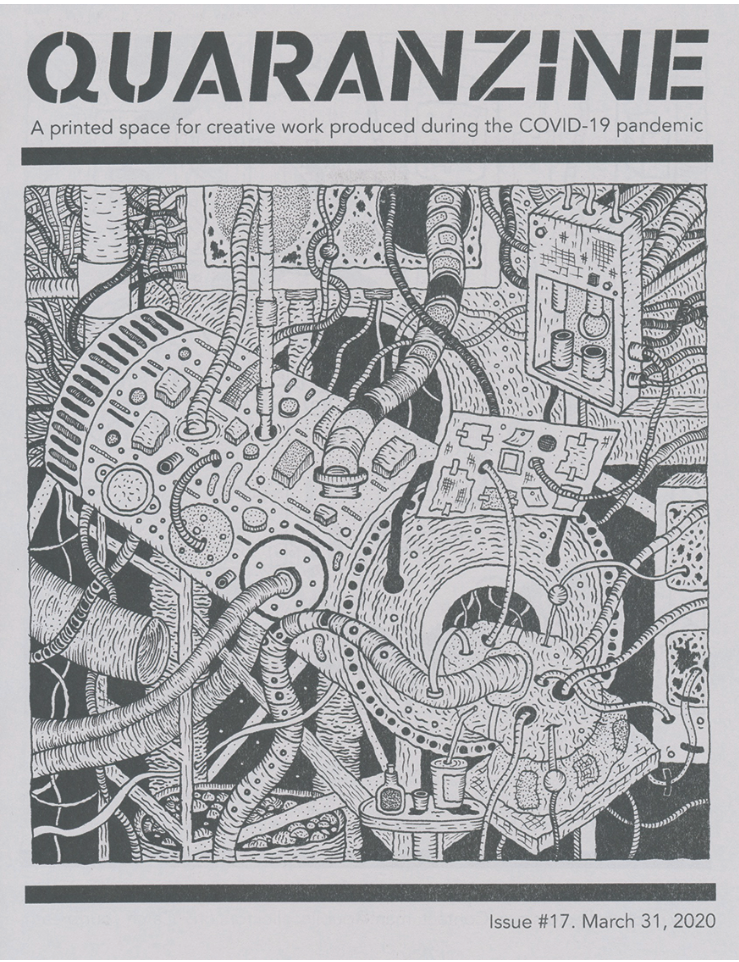
QUARANZINE Issue #17, in collaboration with Paul Nudd. Courtesy of Marc Fischer. We just made this Half Letter Press book with an Italian artist living in Spain, Matteo Guidi. That was a year of going back and forth with everyone and we didn't meet the author until he came to Chicago for two events. We met on the day of the first event.
Lou: And how did that collaboration start, if you hadn't met before?
Marc: Allegra Baggio Corradi, who translated the text, was working with another publisher, and she met us at the New York Art Book Fair and told us about the book, Cooking in Maximum Security about how people cook in Italian maximum security prisons. It had been published in Italian but not in English, and thought that based on our project Prisoners’ Inventions, it might be something we would find interesting and might want to publish.
We looked over the material and it felt very obvious that we should do it, because it feels so much like a sort of relative, an Italian cousin of our Prisoners’ Inventions project. We understood all of the issues around it and were just very sympathetic to everything about it.
So she introduced us to the author and we all worked together until a book was finished. He came to Chicago and we enjoyed meeting him exactly as much as we expected we would. He came here when it was below zero and he’s from Barcelona—it was brutal, the coldest weather he had experienced in his entire life.
Collaboration works in different ways. Different people need different things. If the collaboration takes the form of a publication, the publication becomes a structure for spending time with a person you like. Whether it's three hours during a COVID lockdown or emailing back and forth for a year, and then all the subsequent work of distribution and events become other ways of spending time with people.
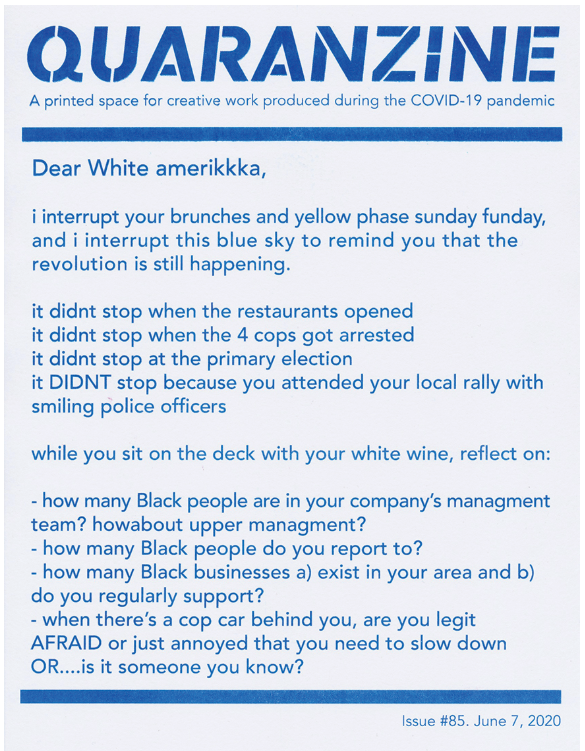
QUARANZINE Issue #85 in collaboration with Shawn Cephas. Courtesy of Marc Fischer.
Lou: I noticed a lot of your stuff is also available online, like Against Competition and that recent publication that you put out, “Why is no one buying my zine at the art book fair?” All of those, they're in printed form, and they're also available for free online. I wonder what the ethic or purpose behind that is for you, and if that's important for you, for it to be accessible to a wider range of people.
Marc: I definitely prefer that people encounter things as physical objects. I don't care at all about people bootlegging the work or something like that—that's a compliment. If anything, most of the time if things aren't distributed as PDFs, it’s because I find managing the work of putting it online tedious. With the way Half Letter Press’s website works, it gets really cluttered and confusing to have two different versions (print and PDFs) of lots of things.
On the Temporary Services website, there are lots of free PDFs that people can download. The Public Collectors website is a mess. Eventually, if I can take my attention off of making new things, it would be nice to have a website for all of my Public Collectors publications, maybe a website just for the publications since there are so many of them, and start making PDFs of things that I just don't wanna reprint anymore.
Part of the thinking of having PDFs increasingly is that overseas shipping is so outrageously expensive and it's good for things that are out of print that I don't want to spend the resources and time reprinting. With Half Letter Press, it's more likely that we’ll make a digital version, especially with this new book, because again, overseas shipping prices are miserable.
It's important that people be able to read things. But also the physical object is what facilitates the sorts of experiences that I like to have. It provides an income, but also it facilitates these in person experiences. There's little reason to travel to events and book fairs if everything is purely digital. Books create physical, social spaces, you know? And libraries and bookstores.
When I'm dead, if someone else wants to invest the time in digitizing everything when I'm not at a point where I can benefit from all the great experiences that come with making physical things, that would be great.
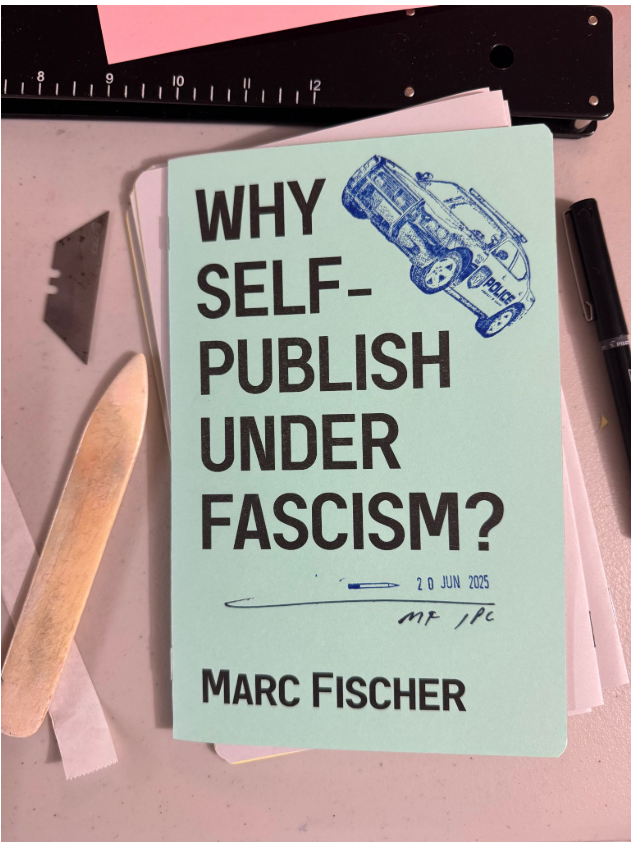
The cover of Why Self-Publish Under Fascism on Marc’s desk. Courtesy of March Fischer.
Lou: That makes me think of your publication Why Self-Publish Under Fascism? which I found really moving, and which helped me articulate a bit of why it feels important to still make things in a moment of such political disaster and social disaster. I love what you're saying about the tangible object, creating that social space in a way that the words themselves don't always do.
I'm curious to hear you talk a little bit more about that work and what inspired you to make it. How you do make sense of publishing under fascism?
Marc: Excuse me. [Marc’s small dog arrives in his wife Jen’s arms and jumps into Marc’s lap]. My dog has basically picked me as his person, but he will do this obnoxious thing where he will hang out with me and then go upstairs and fetch my wife, and make her bring him back downstairs to me. It’s absurd and kind of obnoxious.
So, anyway, Mariame Kaba invited me to participate in this discussion about self-publishing zines in the age of information control. We were going back and forth about it on BlueSky. And I was posting some of the kinds of thoughts that went into the booklet, and Mariame was like, “I hope you're writing down all of this brilliance, so that you remember to say these things when we have this discussion.” And I jokingly said, “Oh, actually I'm printing out thousands of copies of it on the RISO as we speak.”
This was a few weeks before the panel and I just started writing more notes and thought, “I should just publish this and have it done before the event, and it would be like a nice thing to bring and give to people who attend.” The panel discussion was in Chicago, at this space Walls Turned Sideways. Mariame has this incredible legion of followers on social media and stuff, and just a huge audience for her work. Anytime I do something or Half Letter Press is publishing things by her, and she promotes it, I've told her, “Could you give me a heads up before you tell your people so I can plan my week accordingly?” Cause all I'm gonna be doing is packing mail orders and going to the post office. Her support for anything is always really amazing. And she’s also just hilarious and super fun to work with.
Some of the points I make in Why Self-Publish Under Fascism? are issues I'd been thinking about for a while, like the importance of having at least some kind of printer in your living space. Some of the content was sparked by the invitation, which stimulated additional thinking around the freedom that comes with self-publishing. That text has had an amazing life. Everything this past year that's had a huge readership has been something that was written in like a day or two days.
Lou: That's amazing.
Marc: Yeah. It doesn't always work that way. There are other things that take months to write and finish and then you struggle to find 250 people who want a copy. And then the stuff that was just sort of vomited right into my computer everyone loves and wants to share with other people. I've removed or altered my expectations for everything I do, quite a bit.
Lou: To me its popularity speaks to how people are really looking for meaning and instructions in a lot of ways on how to meet this moment. It makes sense it was so impactful, I think.
Marc: Yeah, this year has just been—there are a few things that I haven't promoted as Public Collectors projects or don't worry about whether they are or aren't—that have gone viral online and it has thrown me for quite a loop. There were four different flyers I made around ICE that I first posted on my Instagram. I was reluctant to take responsibility for them, because I wasn't sure what their effect might be, so I just said that I encountered them. At this point I don’t mind taking responsibility.
In Chicago we have these flyers that contractors put up on people's garages offering their services like roofing and garage construction. They're these half sheet flyers, they look like they were printed on a RISO, otherwise they might be litho printed in enormous quantities. The design of them all looks extremely similar to one another, even though the contractors are different businesses. I made a series of these flyers based on the contractor flyer designs, ridiculing ICE and trying to foment hostility toward them.
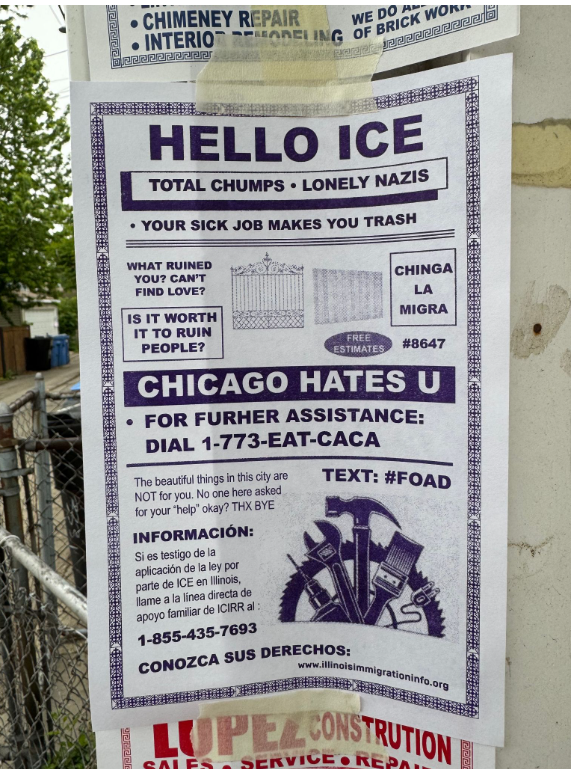
One of Marc’s anti-ICE posters. Courtesy of Marc Fischer.
The insults are really absurd in some cases, but they emulate the style of these contractor flyers that would be up around my neighborhood on people's garages. I’d put mine right under the flyers from these different contractors, partly because a lot of the contractors are undocumented, and I like the idea of them seeing these things made in response.
But those flyers, people saw them online or people found them on their garages or on street poles and started posting them on social media, and then people were like, “How do I get this for our city?” I asked—does your city have this same visual culture? And then people just started making their own versions for their cities when I didn't volunteer that I made them or respond. There's someone in Portland who wanted Portland versions, and I was like, does Portland have that same kind of flyer culture?
Lou: Yeah, not that way.
Marc: Yeah, what's so absurd about the flyers is that there was a phone number for a printer on one of the originals, and I called the phone number and asked how much they charge for printing. And then I asked, “For the flyers for different contractors and roofers, do you just print them or do you also design them?” They said, “Oh, the design is included in the price.” Whoever is printing these for people is also designing them to all look extremely similar. So it's like the complete opposite of having some sort of corporate identity in your business. It just flies in the face of that in a really hilarious way.
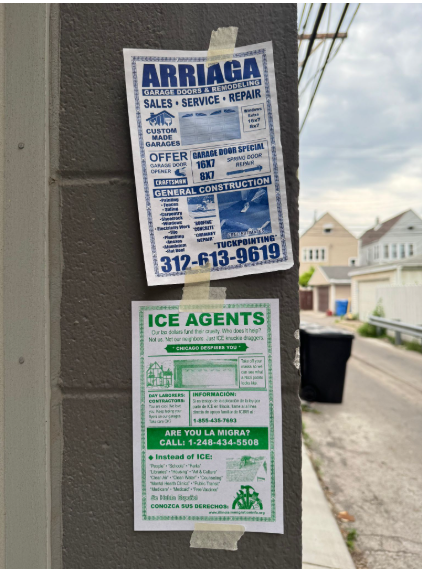
A poster advertising garage door services above one of Marc’s anti-ICE posters. Photo courtesy Marc Fischer.
There were a bunch of gestures last year like those flyers where if I took credit for it and wanted to monetize it, which I just didn't, that would've taken over my life completely. And I was slow to take responsibility because people love them so much and I just didn't wanna deal with that.
Lou: Didn't want to deal with the recognition or take the credit?
Marc: Both. Because then people want to do articles or… this happened over and over again with different things. In Chicago, people on the South Side popularized the idea of distributing whistles to call attention to the presence of ICE agents and Customs and Border Patrol.
And I ordered a ton, like 700 whistles early in September, when ICE were really escalating in Chicago. I was trying to figure out the best way to distribute them to people. I wanted to do some of that in person, but it occurred to me that we have these stupid little free libraries—which I mostly think are recycling bins on a stick–but I was like, “Oh, these would be a really good hands off way to distribute whistles.” If you put enough of them in there you could tell people to go get them from these little free libraries. I think that after posting about that on my neighborhood group, the idea spread and it helped popularize the idea of using little free libraries in that way.
And since then, not because of me, but because of the strategy in general and how effective it is, people have distributed hundreds and hundreds of thousands of whistles throughout Chicago. And it's super effective in terms of getting people out of their houses, like the second they hear that whistle, or out of businesses, as a sign that ICE is present or someone's being detained.
Invariably some reporter wanted to interview me about this. I'm just like, “No!” I got the idea from Mexican people on the South Side, from an article that was published about the use of whistles. They should just interview them. Talk about the idea. I'm not gonna be your heroic white guy.
Lou: I’m thinking about this idea of when to take credit or to not, or when to consider something a project or not. We talk in my MFA program about, when do you projectify life? When something becomes “art” or “social practice” all of a sudden. Do you think about that? Does that matter to you or do you just do what you're called to do?
Marc: Yeah, I think about that. Like with these ICE flyers, this one other artist who makes t-shirts and silkscreened stuff approached me about making them into a t-shirt and selling them, and some of the money could be donated or whatever, and I was just like, no. Two white guys making and selling shirts, even if all of the money was donated….no.
And also the form doesn't need to be a shirt. There should be no elevated version of it. It should be a shitty, cheap flyer that looks like all the other shitty cheap flyers. Like not an art print. And I'm sure people would buy them, I'm sure it would be super successful, but I just didn't think that that form, I don't think that was the appropriate form—I didn't think making shirts was the right spirit for the idea.
In terms of something becoming an art practice, another example comes to mind. I started walking, trying to really massively increase my walking in the past year. Partly for physical and mental health reasons, that was the impetus, but then of course there's tons of visually interesting things. For a while I'd just walk and that's all I would do. And then naturally I started taking photos and noticing themes that would emerge in what I was documenting, and it was like, “oh yeah, of course.” I couldn't just do the thing without turning it into a series of small publications.
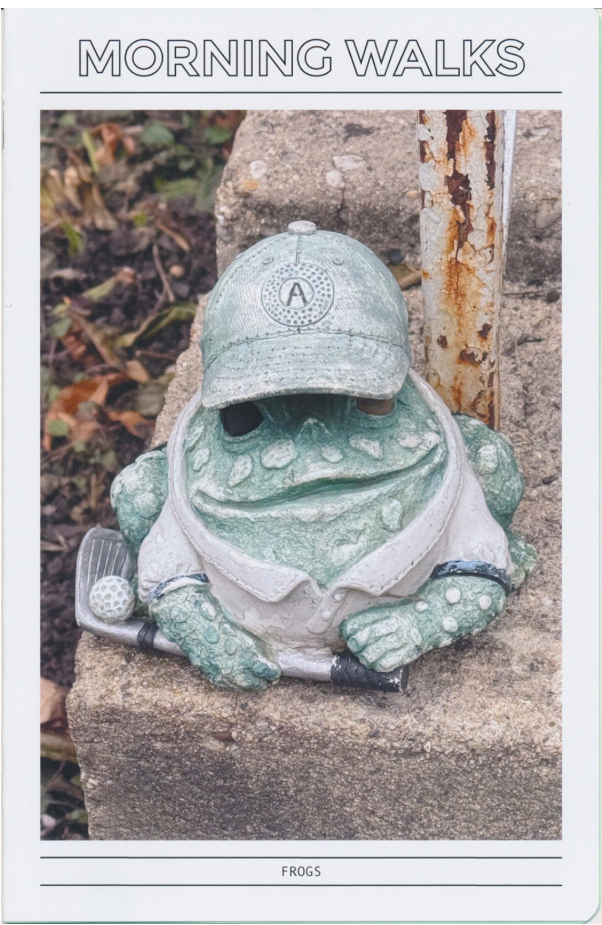
The cover of Morning Walks #7. Courtesy of Marc Fischer.
But also the activity of photographing things sometimes propels you to move through the neighborhood in different ways, or walk further because you haven't documented as much as you hoped to. So sometimes turning something into a project might motivate me to do something that I was already somewhat interested in doing–to do it further or to do it longer. To have a richer experience of an idea than if I was just doing it casually, for fun or something.
When you do a project, it's on your own timeline. Then you can structure your experience however you want. When you get invited to do something, like through an institutional collaboration, something that maybe you would prefer to do in a more organic way… when an institution has all these different needs from you and it gets formalized by someone else, I think that becomes a lot more challenging. And often frustrating.
What I like about publishing is you can do it on your own timeline. Exhibits, you have to wait around and hope that you'll still want to do the thing you’re invited to do a year later when it finally happens. And that's something I've struggled with a lot in this particular time period where you get locked into a commitment to something that is really not what you're feeling later on.
All right, this dog’s gotta go out, he’s just yelling at me to take him outside.
Lou: No worries. Thanks so much, Marc. I really appreciate you taking the time.
————————————
Marc Fischer is the administrator of Public Collectors, an initiative he formed in 2007. Public Collectors’s work brings the periphery to the foreground and elevates marginal perspectives, particularly those that museums ignore. Public Collectors’ work includes the Library Excavations publication series and web project, Hardcore Architecture—a blog and publication series about where people in punk bands lived, the Courtroom Artist Residency Program, and Quaranzine—which produced 100 single page publications with over 75 collaborators at the start of the COVID-19 pandemic. In addition to Quaranzine, Public Collectors has produced nearly 110 publications. Fischer is also a member of the group Temporary Services (founded in 1998) and a partner in its publishing imprint Half Letter Press (ongoing since 2008). He is based in Chicago.
Lou Blumberg is an artist, facilitator, and educator born and raised in San Francisco, grown in New Orleans, and living in Portland, Oregon. With a belief that better worlds are possible, their deeply personal practice treats conflict as creative potential for our relationships and lives, examines surveillance and narratives of safety, and urges more feeling in despairing times. They co-organize a reproductive justice-focused online space that supports organizations working towards bodily autonomy for all, and facilitate workshops on topics like disagreement, digital security, and singing. Lou taught sex education for ten years in Chicago and New Orleans, organizes with anti-surveillance and anti-zionist movements, and is a trained mediator.
