
Text by Clara Harlow with Hannah and Tessa Harlow
“The fact that I've had to live a life and go to work is very silly and so let's make the best of it.” - Tessa Harlow
Okay, you clocked me. I’m a middle child. I’ve always felt most comfortable in the center—whether that’s in the bed at a sleepover, an argument, a friend group. Being in the middle means there’s always something on either side of you giving you a sense of belonging. Being in the middle means you never get left behind.
But more than my birth order, I’ve found personal definition in the sisterhood that made me a middle. What does being a sister entail, you may ask? A sister is your most honest critic and relentless cheerleader. A sister is a witness of shared mundanity, profundity, and everything in between. She’s seen every version of who you were and will never let you live it down. She sees each iteration of who you’re becoming and will ride for that person every day forever. After all, only she can say that about her sister.
My sisters Hannah and Tessa were my first collaborators, teachers, and friends. We were all born 20 months apart in the same hospital across the street from the place with the $1 margaritas. Whether by choice or force, we shared most things: bedrooms, a love of swimming, genetics that protected us from cavities but not acne, a desire to have the last word, our obsession with Heath Ledger in the 1999 film 10 Things I Hate About You, and, most especially, time. We cohabitated a spongy expanse of free time that seemed to go on forever and ever, until abruptly, it didn’t anymore. Together we gave shape to this time through the invention of games, schemes, alter egos, bogus business ventures, art projects, and backyard carnivals. We didn’t know we were building a childhood together, we just knew we were never too far apart. Around the neighborhood, local swimming pool, and our dad’s office building we made a name for ourselves. They called us the Harlow Girls.
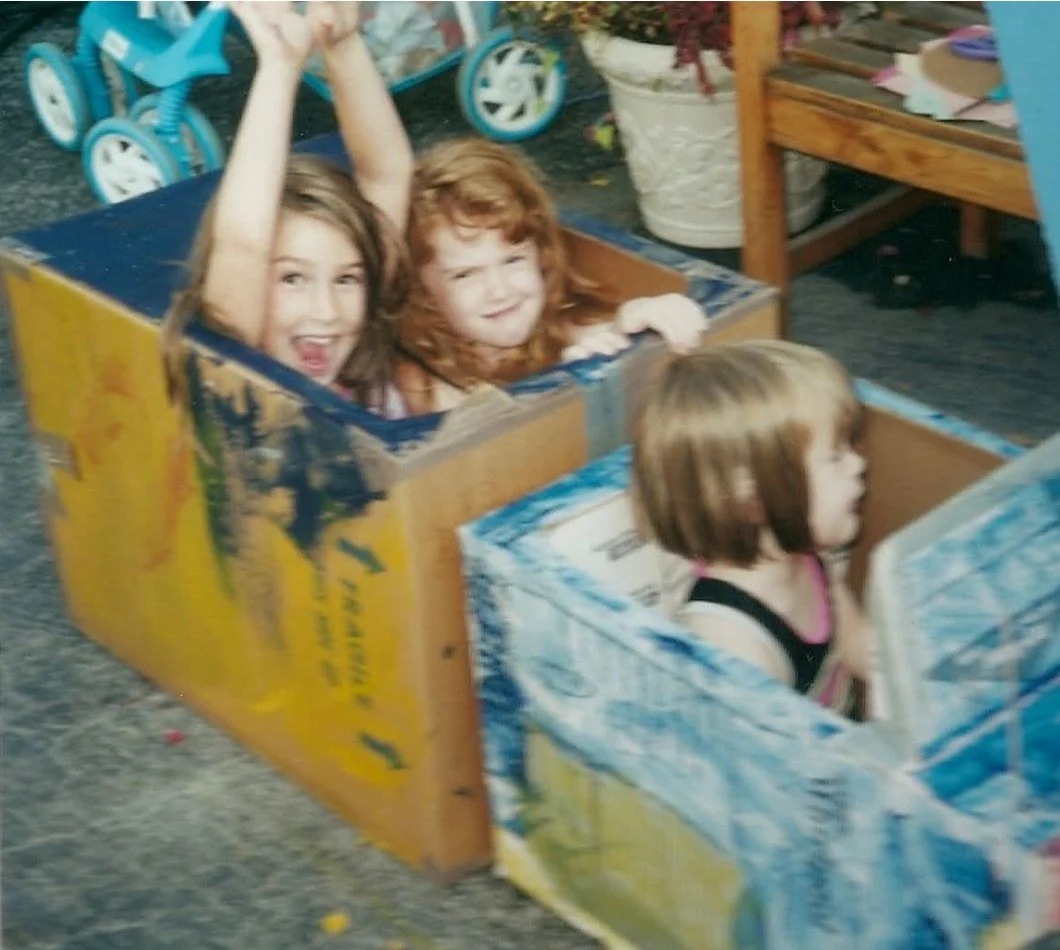
Cardboard was a treasured material in the Harlow House. We took a page out of our favorite book, Christina Katerina and the Box by Patricia Lee Gauch, and repurposed it endlessly until it gave out. Photo by Therese Straseski.
Clara Harlow: In many ways, I feel like the work that I make as an artist is kind of an attempt to get back to that place of worldbuilding and co-creating that we had access to as kids. So I just wanted to say thank you. Thanks for being such great pals, and being down to make weird things together, like, you know, Ooey Gooey Land, for one.
Hannah Harlow: What’s Ooey Gooey land?
Tessa Harlow: You weren't a part of that.
Hannah: Oh, okay, good, because I was like, I don't remember that.
Clara Harlow: Yeah, it was kind of a me and Tessa thing.
Hannah: Oh, okay.
Tessa: You were too cool for it.
Clara: Yeah, it sort of, like, involves make-believe. And also chewing gum. That's how you got to Ooey Gooey Land, if that’s not obvious.
So anyway, to begin, what is it you guys think that I do?
Tessa: That's a really good question.
Hannah: I always say that you study art and social practice. Which… means that you are understanding a community in order to collaborate with them, and create art that reflects their experiences?
Clara: That's really good, Hannah!
Hannah: Oh, phew, okay.
Tessa: Pretty textbook, don't you think?
Hannah: So, you got anything better than that?
Tessa: I mean, I think that you are seeking moments of play, and sometimes that is by yourself, when you are out and about, and you see moments, kind of like snippets of joy, and snippets of the way that you can see the world playfully. And then I think other times it is how you can include other people, and taking a beat and returning to joy a little bit together.
Clara: Yeah. Wow, these are really good answers, you guys, I'm very impressed.
Tessa: Yeah, on the record, whose answer was better?
Clara: I’ll tell you off the record. So, what do you think you miss about the way that we shared our life and time together in our childhood?
Tessa: I would say the openness for making a mess and access to a lot of materials. And the ability to kind of just do what you need to do, or what you want to do. Most of the time, those were kind of kid-friendly things, but every once in a while, depending on our parents’ time and their availability, they were willing to kind of facilitate what that meant or how we could better use tools to achieve that. Like when I was in first grade we drew a new type of bug, and I liked my bug so much the following weekend dad cut it out of wood and I got to paint it.
Hannah: I just feel like that question is so hard because it's, like, EVERYTHING??
Tessa: Well, I would also say, when I was visiting Hannah, it was really fun to see [Hannah’s friend] Gordon interact with his sisters. How he and his sister Francis get to live in the same city, and have some of those silly times together as adults is really cool.
Clara: Right, I feel like something you're hitting on is this sort of shared language that you're creating. And you have all these shared reference points and there's a lot of overlap in the framework that helped shape you and how you related to the world when you were young. And so then when you're back together, there's a lot of good material you can pull on that you all have in common. It’s like a sibling shorthand.
Hannah: I think there's also just an ease to having all those shared references. I think you can lose so much focus on enjoying time together if you're also using a different muscle to just gauge, like, Is this person enjoying me? Should I not have said that? There's just sort of an ultimate comfort that comes with being with people that have known you for 30 years, you know?
Clara: Oh totally. Also for me there’s that element of shared boredom in having spent so much time together and what can organically emerge when we’re trying to entertain ourselves and each other.
Hannah: True, because I feel like I could do literally anything with the both of you and it'd be fun.
Clara: Aww.
Hannah: Especially the boring stuff.
Clara: Yeah, there's a real comfort and familiarity, and just kind of, like, come as you are, we might get annoyed at you, but we still love you.
Hannah: Exactly. And you would tell me if I was annoying you, too.
Clara: Aha that's right. There's a real spirit of directness.
Hannah: You wouldn't let me forget it.
Clara: I'm curious what you think is something that you can do, be, or access with your siblings that you can't with other people?
Tessa: I mean, I think that there is always the shared past and shared memories. As we come into adulthood, it's been very interesting to connect with how it was viewed by each other almost as a way to kind of fact check, like, is that what really happened? And I think all three of us have had conversations about birth order and how that changes how our parents treated us. You can kind of check in to be like, oh, that happened to you, that never happened to me because it happened to you, kind of thing.
Hannah: I agree.
Clara: Yeah, it's like you're carrying this sort of niche family lore together, or something. There’s storytelling and archiving that happens amongst siblings, whereas if you're an only child, that's all on you. I feel like that would be very lonely, no one to be in cahoots with, you know? Or potentially a lot of responsibility too at times.
What do you think is something you learned in having sisters? Like braiding, for instance.
Tessa: I don't know if I learned that from sisters.
Clara: Mom?
Hannah: Who's a different kind of sister, older than us, sister.
Clara: Well Hannah taught me how to shave my legs.
Hannah: Oh, that's nice of me? I don't remember that at all. I think about disagreeing and then continuing to be able to operate together, you know?
Tessa: Well, I was gonna say almost the opposite. Sometimes I can't let things go, because I knew that I could fight and it would just be over at a certain point and then we would just move on. And especially having friends who have grown up with brothers, they can't handle that well. There is a certain level of, like, not nastiness, but bickering that I think comes from having sisters, but I do understand that that's, like, unpleasant to other people.
Clara: Right, it kind of changes your relationship to conflict perhaps. Like, it's not maybe so scary or taboo, or something? It’s sort of like we've had a lot of practice with each other being in conflict and finding different ways to move through that and resolve it, repair it, or sometimes not and then figuring out the consequences of that, you know?
Hannah: Well, that is kind of fascinating, because I think I've always had a hard time with friends that hold grudges, when they’re like, “That person's dead to me,” and you as their friend are expected to also hold onto that burden. I think I just am not built like that necessarily. It's not like if you personally are wronged, that that doesn't linger, but I think I can start fresh a little bit quicker than I think I've observed some of my friends can, you know?
Tessa: I also learned how to make friendship bracelets.
Clara: Yeah, all sorts of making. There was a real resourcefulness too in our shenanigans, just using the things we had around us to make our own fun. Like, I'm thinking about all the different plays and carnivals we used to throw in the backyard, the pop-up art museums, or little towns that had different services and commerce. How do you guys think you access that sense of play in your daily life as adults?
Hannah: I think that I'm very lucky to have a job [as a producer at a news channel in Chicago] that kind of requires play. Between the morning show and [the daily news recap show] What A Day, I think playfulness and having a rapport with coworkers is important for the content. Like the time that you spend gabbing about nothing can then be the kernels that could be a segment or a conversation on What A Day, or an ongoing bit on the morning show.
A recent example of that came up the other day. We have a morning show meeting after the show every day, and one of the executive producers was saying that his heater got stolen out of his office, and so then that became a whole thing. We were all on the case trying to figure that out. Like I edited a milk carton with a picture of the heater on it that said Missing, and so then, that graphic got put on the show, and it just became a daily update on the heater until somebody did find it.
Tessa: So, did you steal it?
Hannah: No!
Clara: Off the record, did you?
Hannah: On the record, no, I didn't.
Clara: Yeah, it's like the material is your relationships and the pockets in between where this playtime can be activated. And that can go back into what you do as material for the show, so it's to everyone's benefit for you guys to be having fun together in some way. That’s really not so dissimilar to what I do too.
Hannah: Yes. That's very well put. And I think when a workplace starts to cut jobs, people are burdened to do more with less. So there's so much less time to be goofy, and that's where the office culture can really change because you can have those moments of fun, but it's going to cost you at a different part in your day. Or because of the heightened workload, you just kind of have to ice out people that are trying to get you off task and that kind of sucks, too
Clara: Tessa, how do you think you play in your daily life as an adult?
Tessa: Not every time, but sometimes going to the gym. I think going to the gym is sometimes very painful, but there are days where you kind of just fuck around. And I think it was more so —Hannah probably gets this—at the climbing gym. It's just kind of silly and nice to have an opportunity to connect with your body.
Hannah: I always call it recess.
Tessa: I think that whenever I make little things, that's kind of playing too.
Clara: Yeah like your Diorama Night! Do you consider that as playing?
Tessa: Yeah. I think so. Look what I’m making right now.
[Holds up an intricate garland of hand drawn gingerbread houses rendered in a variety of architectural styles]
Tessa: We all become our [historical architect] fathers one day.
Hannah: Yeah, I was gonna say…
Clara: What else allows you to be able to access play in your daily life? What do you need? Time? Sleep?
Tessa: I think, sometimes just the opposite. Being tired and just kind of being like, well, the fact that I've had to live a life and go to work is very silly, and so let's make the best of it.
Clara: Totally! I really relate to that.
Hannah: I would say time is very helpful for me, because a lot of the day I'm kind of, like, behind the 8-ball. Especially at work, I feel like I just always kind of have a deadline that I really could use like 15 more minutes on, you know what I mean? But when I have a little breathing room, then I think it makes it easier to play.
Clara: Yeah that makes sense. I feel like there are so many tasks in a day to get through and play questions that a little bit. Like, what are the important tasks here, really? Or if life is like this all the time, like, we just have to do all this shit all the time and it's never over, then how can we enjoy it a little bit more? Even when it’s a mess or so exhausting or whatever. How do we keep finding interest and attention and connection? Because this is the thing right here, we’re in it, it’s happening.
Tessa: And, I mean, what are we doing if not playing? On the record? This is playful.
Clara: On the record? I love you.
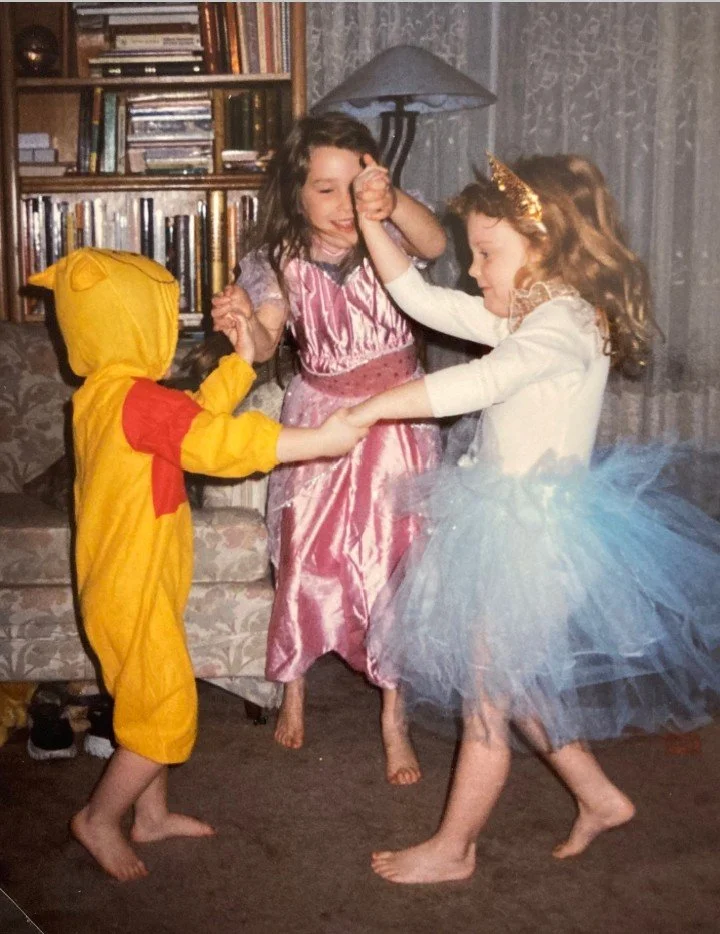
It’s challenging to fully convey the influence my sisters had on the artist and person I became. All I can say is, I am me because I had them. And when I don’t know, they remember. Together we keep learning what it means to be in relationship over and over again. Laughter, eyerolls and all. Photo by Therese Straseski.
————————————
Hannah Harlow is a film enthusiast and producer at Chicago’s local news channel WGN where she works on the daily recap show What A Day. She lives on the northside with her dog Zuzu and has a tattoo of the Chicago flag on her foot. Hannah is the oldest sister and is always right.
Tessa Harlow runs a tight ship at a bakery in Boston. They can often be found cooking new recipes with their wife or working on one of countless ongoing projects. Tessa is the youngest sister and is actually always right.
