
Artists on Visa
Text by Simeen Anjum with Khytul Abyad
“This contradiction isn’t accidental. Institutional “community” is an aesthetic and a marketing tool. When students enact political contestation rather than perform it in classrooms or artist statements, they are disciplined. So the question becomes: What does it mean when values only exist in syllabi and marketing language, but collapse the moment they are practiced?” — Khytul Abyad
Khytul Abyad is a Chicago-based artist originally from Indian Occupied Kashmir. Her work is deeply shaped by her experience growing up under a military occupation mixed with the wonder and delights of local folktales, friendships and community. I speak with her about how geography has influenced her practice and particularly her experience of making work in the United States as a recent graduate from SAIC navigating life across multiple locations.
I have had the opportunity to follow Khytul’s work from Kashmir and through the many places life has taken her. For some time, I have been thinking about immigration systems, especially in the context of living in the United States during Trump’s second presidency and the chaos and fear unleashed by Immigration and Customs Enforcement across communities nationwide.
Being on a student visa which is already incredibly difficult to obtain and then witnessing rapid shifts in what is permitted or prohibited, what visa holders can say, where they can travel, and how they are surveilled, has marked a deeply unsettling moment for many of us. It often feels as though the rules are no longer legible, or that the rules we once knew no longer exist.
With these concerns in mind, I speak with Khytul about the significance of place in her life—how movement across geographies shapes her creative practice, and how living between locations informs her understanding of home, freedom, and constraint.
Simeen Anjum: Tell me about your ongoing practice and how it has shifted lately.
Khytul Abyad: My work is (very) multidisciplinary. I'm exploring comics, a medium I'm fairly new to, and experimenting with materials. The material based works include drawing, sculpture, installations.
Bringing to an end my artistic exploration that continued in three (!) art schools, one year ago, I decided to make my practice more “integrated”.
With the way the world has shaped in the last few years, I've been conscious of the tendency, when you're in academia, to dissociate from the real world and start making work in a bubble, and I've been asking what it means to make art in this time.
Simeen: You spoke about the tendency to make art in a bubble but I know that you are also systemically excluded from that bubble, like being a kashmiri person in India or even being in SAIC and making the kind of art that you do.
Khytul: When I say “bubble,” I don’t mean that I was ever fully inside it in a way that felt secure. Creatively, maybe, but every time I started to get comfortable within the system, something would jolt me back into remembering that I was an outsider. That reminder came in different forms: through the curriculum, through the way history was taught, through what kinds of work were legible or valued.
I think what happens naturally in institutions like this is that you start believing in this idea of a coherent “community”, everyone talks about it. It feels effortless while you’re there. But once you graduate, it dissolves almost immediately.
So when I say bubble, I’m also talking about that illusion, the belief that this structure will hold you, that it’s something you can rely on.
For me, being systemically excluded meant I was always aware of how fragile and transactional it was. In that sense, the idea of community as it’s sold to you is kind of a scam, because institutions benefit from you believing it is real.
Simeen: There is definitely something about the word ‘community’ that is so overused by institutions. And we have recently seen how schools including SAIC have responded to the student encampments for Palestine. There is a lot of hypocrisy because they clearly do not care about the community.
I was reading this essay about how diversity and multiculturalism as we see in our schools today is constructed by neoliberalism. It's like something to market. These new constructions of diversity remove political contestation in favor of simple math problems resulting in international students as a way to promote diversity because they pay “boat-loads of money.” As in, international students are the worthy subjects of diversity promotion because they represent wealthy new markets versus dependent poor people in the home market. This kind of removes the political power of diversity to challenge discrimination in universities.
Khytul: We’ve seen very clearly over the last two years that a lot of this is just rhetoric. SAIC markets itself as a space for queer people, that’s part of its brand. But when many of those same queer students participated in the encampments for Palestine, within the first hour around seventy students were arrested. People were misgendered, and physically harmed.
This contradiction isn’t accidental. Institutional “community” is an aesthetic and a marketing tool.
When students enact political contestation rather than perform it in classrooms or artist statements, they are disciplined. So the question becomes: What does it mean when values only exist in syllabi and marketing language, but collapse the moment they are practiced?
Simeen: Definitely. At Portland State, the director of the Women’s Resource Center was fired without any explanation. Students and faculty have also been continually harassed for advocating for Palestine. I remember that during the encampments, international students like me received emails from the school saying that while they supported our freedom of speech, we could be sent back to our home countries if we participated in the protests. In fact, several international students did have their visas canceled and were forced to leave.
According to a Hyperallergic article, international art students are among the most vulnerable groups in the art world right now. What has your experience with the U.S. visa system been like?
Khytul: This has honestly been the most difficult part of being here. When I first applied to come to the U.S., I fully expected my visa to be rejected. I’m a Kashmiri person with an Indian passport who had also studied in Pakistan, and everyone told me the same thing: once you go to Pakistan, your mobility is essentially over. That you won’t be able to travel anywhere else.
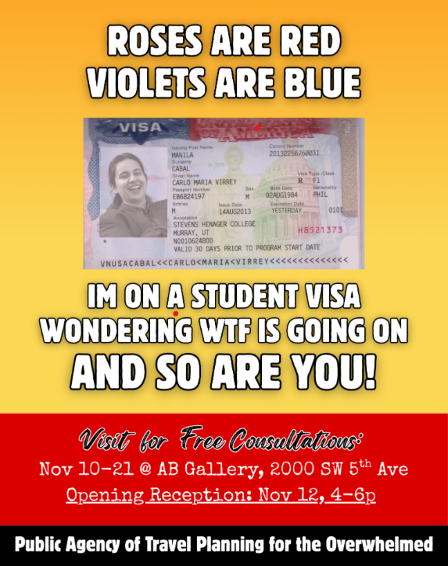
Flyer from Simeen Anjum’s show in AB Gallery, Portland centering the experiences of the international student community in Portland State.
Simeen: Did you care at that time?
Khytul: I did not! An opportunity was in front of me, and I jumped right into it. I went to Pakistan for my master’s degree.
So when I finally applied to study in the U.S., I didn’t even believe I would get my visa. That fear was constant, and it never really goes away.
After graduating, the reality becomes even harsher. I’ve applied to over 300 jobs, artist residencies, and opportunities, and most of the time there isn’t even a rejection. And in rare moments when I am shortlisted, as soon as my visa status comes up, things change.
With the current political climate, there’s a growing reluctance to work with or hire international students. We’re seen as administrative burdens.
I could have pursued an artist visa, but for me it didn’t make sense financially, emotionally, or ethically. It’s another system that requires you to prove exceptional worth just to exist and work, and I was already exhausted from having to constantly justify my presence.
What makes international art students especially vulnerable is this combination of precarity and invisibility. You’re expected to contribute to the cultural life of these institutions, but once you graduate, there’s no real infrastructure to support you staying, working, or surviving. You’re left in limbo, legally, professionally, and psychologically.
Simeen: I think having $10,000 as an artist is still like an American Dream for me.
Khytul: I'm living it right now, and I'd say it's a nightmare.
Simeen: I also think that places play such a role in your practice. Your work is largely about Kashmir and your life there, but then you have worked in Pakistan and India, and now in the US. And all these places have so many tensions amongst them. Does your relationship with a place show up in your practice?
Khytul: Yes, absolutely. Place plays a huge role in my practice, both materially and psychologically. For instance, being in Chicago has changed my relationship to time and attention. Here, I don’t feel the same constant pressure or alertness. I can step outside, take a walk between work sessions, and clear my head. That kind of ordinary calm is not something I could ever assume in Kashmir. There, even something as simple as going for a walk carried uncertainty.
But it’s also not just about geography. It’s about who you’re surrounded by, and whether your environment allows you space to think. For a long time, my work felt like documentation because I was living inside continuous disruption. When you’re constantly responding to a crisis, your art becomes reactive by necessity. If I were still in Kashmir, I think I would still be making very direct work, because there wouldn’t be room for anything else.
Simeen: And in terms of place, your work has shifted from a more serious tone toward something more fictional and joyful.
Khytul: Yes. There's physical distance, but there's emotional distance as well. That distance gave me perspective, and with it, a different kind of freedom. I’m able to speak more honestly on my own terms now, rather than only responding to what’s immediately happening around me. At the same time, that distance also produces nostalgia, and nostalgia is something I’m very cautious about in my work. It can flatten complexity, so I’m constantly asking myself how to resist that impulse and remain accountable to the reality of that experience.
But I’m in a better place now, and there’s potential for so much more; for fun, for joy. That sense of freedom I feel now shows up in my work, even when I’m talking about something grim. I’m able to remember the fullness of life that existed alongside the violence, all the fun and tenderness that surrounded me back then.
Simeen: Is there any fun thing that you did in Kashmir as a child floating in your mind right now?
Khytul: Yeah! It’s funny how memory works. Since I’ve been working on comics, I’ve been remembering things I hadn’t thought about in over twenty years. We had so much fun as children, I don’t even know where to start.
We used to go to Sherbagh, where we would all bathe in this big pond. I couldn’t swim, so one time one of my brothers said, “I’m going to teach you how to swim, okay? I’ll hold your legs, and you just wave your arms.” So we tried that. He was holding my legs and waiting for me to start waving my arms. But my head was under the water and I was struggling to breathe.
Some men walking by noticed and said, “Look, your sister is drowning!” He pulled me out quickly, and they had to press on my chest because I was choking on water. And in that same pond, another time, my cousin fell in and was underwater for a while. When we pulled her out, there was a fish biting her lips.
Things like that felt completely normal to us growing up.
Simeen: That sounds scary. What is the farthest you went away from home as a kid without your parents knowing?
Khytul: I usually tried to stay within my neighborhood and not wander too far. But one time, my uncle and his daughter were going to see their house, in a different part of the town. It was still under construction, and I went along with them.
He drove us there, and we spent the afternoon moving between the house and the surrounding neighborhood, playing, drinking chai, and passing time together. There was a large playground nearby, and my cousin and I ran around it, talking and making plans for the future. I remember telling her, “When you move here, we’ll play in this playground all the time.”
By the time I returned home, it was already dark.
When I arrived, all the women in my neighborhood were gathered outside. They thought I had been kidnapped or gone missing. When they saw me, no one said anything. They quietly dispersed and returned to their homes. My mother was on the verge of tears. She slapped me and asked, “Where did you go?”
That was the farthest I ever went.
Simeen: Why is it important for you to draw these stories?
Khytul: Our stories are usually told from the perspective of the nation-state, from the language of borders, security, and “keeping peace” in the subcontinent. In those narratives, our humanity gets surrendered and we often become headlines.
I draw these stories to show the richness of life that exists beyond that framing. To show what childhood in Kashmir actually felt like; the small, ordinary moments where people looked out for one another. We would get lost, and neighbors would bring us home.
We grow up knowing that this is a violent place but we also know that there is always someone who will intervene, someone who will bring you home.
The stories I’m drawing are about what the word “community” actually means in practice. They’re about how we live with and for one another, even under conditions meant to cause stirs.
I also write and draw to juggle with memory: to remember, to access parts of myself that would otherwise slip away, to relive, to preserve. It’s a way to hold onto experiences.
————————————
Khytul Abyad (she/her) is a Chicago-based interdisciplinary artist and writer working across comics, drawing, writing, and installation. Her practice is grounded in the narrative and material languages of dreams, myths, folklore, rituals, and oral lore–forms she uses as counter-archives to map place, memory, and lived experience outside institutional frames. Growing up in militarized Kashmir deeply shapes her work, where personal history and political reality converge as sites of inquiry, tension, and imaginative reconstruction.
Simeen Anjum (she/her) is a social practice artist and museum educator. In her practice, she explores new ways of fostering solidarity and community in response to the late-capitalist world that often isolates us. Her projects take many forms, including sunset-watching gatherings, resting spaces in malls, and singing circles in unexpected locations. She is based in Portland, where she works as a learning guide at the Portland Art Museum.
