
If You Don’t Pass It On, You’re Stuck
Text by Peery Sloan with Josephine LaCosta and Rose Lewis, from School of Each Other: Session One
“If you don’t share what you know, you’re stuck. You won’t cross the river.” - Josephine LaCosta
The School of Each Other began simply: Rose Lewis and I believe that the most interesting education we'd ever received had happened outside of any institution, at kitchen tables, on farms, in parking lots after events where the real conversation finally started. Each session, we invite one person to come teach, not because of their credentials, but because of what life experience they carry. For our first session, Rose insisted on Josephine LaCosta. I didn't know Jo yet. We met sharing a cutting board in Rose's kitchen in the hours before the event, and that's when I understood why Rose had Jo in mind. Jo is fully rigorous and fully generous at the same time, ambitious without ego, honest in a way that invites honesty back. She leads with heart, not credentials. What follows is an edited transcript of that session, drawn from a live recording that was imperfect, low quality, interrupted in places. The beginning and end were lost. But what remains is Josephine: on Cornwall and Coombeshead Farm, a 66-acre working farm that became an unlikely classroom, on stone circles and soul peace, on feeding people who are busy learning other things, on what it means to pass something on before you cross the river.
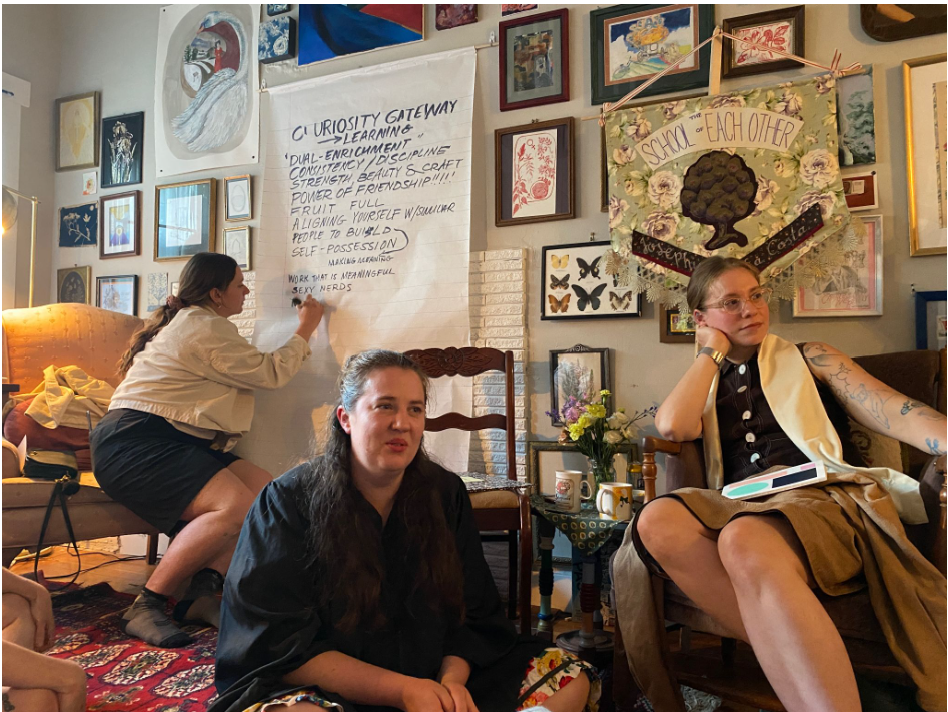
Josephine LaCosta (right) listening as the room reflects back what they’ve learned from her during the evening. Rose Lewis (center) and Jade Novarino (left) taking notes.
Peery Sloan: It’s not cold anymore…it’s getting warmer.
Josephine LaCosta: Yeah. I did that: cold emailed Coombeshead Farm in Cornwall. I remember the cover letter I sent them: it was, "These are the skills I have and can offer and these are the skills I want to learn."
Coombeshead is a 66-acre working farm in Cornwall with a bakery, restaurant, butchery, and a B’n’B on site. They raise a variety of livestock within a regenerative agricultural system alongside a vegetable garden, crop house, and full production kitchen. What makes it remarkable is how seamless the entity is. And where they do have to outsource, it comes from really close by.
Going in, I had already spent a few years working on vegetable farms here in Portland. I had ten years of cooking experience and a little bit of front-of-house as well. So I basically said, "I'll do as much as is needed in the garden, but I really want to learn whole-animal butchery. I want to learn baking because I had very little experience there."
Those were the skills I went to learn. I got all of that, but the thing I really came back with was a kind of soul peace. Going somewhere where you don’t know anyone and throwing yourself into something, despite how cringe or embarrassing it might be, can do a lot for your soul and your ego.
The minutiae of the skills, all of that, I still carry with me and will pass on as soon as I can; I’m already starting to in different ways. But that self-possession, that’s something that can really sustain you. And when other people see that in me, they want that for themselves.
It was very warm. It’s so pretty. It’s pretty cool.
Often when you go into experiences like that, you go in wide-eyed and naive, wanting it to be this beautiful experience. Most of the time you get disillusioned. I know that from experience. But this was one of those rare experiences where I feel like I left with deeper rose-colored glasses than I arrived with.
People really worked as a team there. Nobody got paid much at all. Everybody worked 16-hour days, and the owner worked harder than everyone. He’s just a tireless person with no “off” switch, just go, and an endless sense of humor, and a lot of generosity and kindness.
That team-oriented mentality is alive in a lot of kitchens, but something about being more rural, not knowing many people, and everybody living close to the farm… Before or after a shift the ocean was 20 minutes in every direction, so you’d just go with the crew to spend your time off. You spend all your hours with them or alone.
It was pretty special. There wasn’t much room for bullshit or sabotage. Those are your people. If they’re not happy with you, and you’re not happy with them, you’re not going to make it. You’re not going to get any joy out of it. At least love the people you work with.
Rose Lewis: Do you think the kind of artistically generative atmosphere of Cornwall contributed to that?
Josephine: Cornwall is one of the most magical places on earth. I had no idea going in. It’s very old Celtic land with old traditions and stone circles everywhere, and a feeling of spirits, and beautiful, very old artwork.
It’s different. There’s less… less chaos, maybe because it’s more rural. That older energy can help your nervous system. It’s hard to put into words.
Number one, no one ever talks about their feelings. The conversation is either wit and banter, back and forth, or people talking about a film, or an art show, or an NTS station. There wasn’t a lot of TV talk, and not a lot of “my life” talk. It was very humorous most of the time and really centered away from the self.
That was an adjustment, but I miss it sometimes. Not all the time, but I feel like there’s some balance there. Portland feels totally on the other side of that.
Rose: You have this collaborative farming practice with Jade and then fed her calligraphy students lunch from that farm every week. What did it feel like to have food be a support beam to someone else's learning rather than the main event?
Josephine: In a term that Kye Grant used with me, it was completing for me. I remember when Kye first moved to Portland; there was a bonfire, drinks were involved.
I had this “aha” career moment: I want to be–maybe not literally, but in some way –making school lunches. I want to make food for people who are focusing on other things. I want to offer sustenance and nutrition, a good meal, for people engaged in a workshop or watching a performance or getting into something else.
Food culture has gotten so insanely blown out of proportion in terms of the level of focus put on the high level, even the mid-level of it. We’re all so ridiculously and unnecessarily obsessed.
The best chefs in the country cook food for the fewest number of people, and that’s a huge problem. There are bigger fish to fry, problems to solve, and things people should focus on. Almost anything people can focus on at this point is better than what’s going on.
Food has been taken and run with by the media empire ruling over us all. It’s instant gratification, beautified, and we become addicted to it on screens. We have to engage with food at least three times a day, so it’s over and over again. The form of food and eating has lent itself to that and created a major problem.
I loved that experience of feeding people who were learning, and I’m really going to try to find a way to bring some elements of that back as I move forward.
Another aspect of what I do that feels a little unique to me is my relationship with farming and producing. I’m often confronted with gluts and abundance, and you have to find ways of saving things. Then there are times of year when you’re not farming and nothing is growing. Here we’re pretty lucky; that time doesn’t last very long, but still, there are times when you have to open jars and cans and preserve things.
We should be doing more of that.
Peery: You have an extensive writing practice, shown currently in your substack and through your facilitation of Writers’ Room. Can you talk about the position of writing in your practice as it relates to your culinary adventures?
Josephine: I’ve always written and enjoyed words and reading. Writing has always been with me. Cooking didn’t really come to me until college or after college, so writing came first. It doesn’t feel like writing grew out of cooking; it lives alongside it.
The Writers Room is cool. It’s an open group that meets in a decentralized way, by anyone, for anyone. I started it, but I designed it so it could be picked up by anyone at any time who wants to host it at their house or in a park.
The only guidelines are: pick a prompt and run the prompt with people in the group.
I started it around the time I got more serious about fitness. I wanted a generative writing space that felt like accountability, like we were stretching our writing muscles together: a writing gym.
I got the idea for the decentralized format from a project called Keeping Bread that started in Chicago and got picked up in Portland a few years ago after the pandemic. It was a gathering where people made soup and bread and offered it on a sliding scale.
They then made a website that explained how to do this in your city. I loved that idea: “Yes, we came up with this project, but we built it so it’s transferable, not for profit. Here’s how to make this kind of thing happen in your town or city.”
People want to be helpful and organize things like that, but they don’t know the steps. It’s really cool to see something laid out. I was inspired by that, and the Writers Room came out of it in some way, especially the decentralized format.
Prompts are everywhere; sometimes they come to you, sometimes you find them.
We don’t often prompt ourselves or each other unless we’re on a first or second date or a “friend date.” We fall out of the practice of prompting one another unless you’re just naturally good at interviewing, which feels like a rarer skill.
Peery: I wonder more about what you said: the need for rigor in your writing practice came up as you were instituting more rigor in your physical practice. Tell us more about that.
Josephine: With any form of discipline, consistency is the most important thing. Since I’ve gotten stronger, I read more, I write more, I go on more walks, I cook more for myself. I’ve found more minutes in the day to do the other things I want to be more dedicated to and more disciplined about.
Fitness can be a gateway to finding more time for other things you care about. It’s a pretty quick feedback loop: if you put time into it, you feel a difference in your body.
With other habits, if you start reading regularly for a few months you might wonder, “Is my vocabulary better? Am I actually smarter?” But when you work out for two months, you can tell: “I can lift five more pounds than I could four weeks ago.” It’s literal and a quick way to prove to yourself that you can get better.
Rose: How does all this connect to your sense of career and your work in the world?
Josephine: Maybe in a meta way: I really want to see people sharing more with each other.
I was in Baja with my friend Laura a few years ago, and we met this really cool local guy who is a mezcal maker. We had a late mezcal night with him and he said something that will stick with me forever:
“In my family, it is said that if you don’t pass on the things that you know in your lifetime, your soul’s weight will be too heavy to cross over the river to the spirit world.”
If you don’t share what you know, you’re stuck. You won’t cross the river.
Kitchens are very gatekeeping. And right now we live in a culture where gates are being kept all over the place but especially in kitchens.
I really believe in sharing skills and trying to pass things on.
————————————
Josephine LaCosta has spent her career at the intersection of growing, cooking, and writing, running Elbow's Catering out of Portland, Oregon, where she approaches the table as the most democratic space in any building. She founded the Writers’ Room so that rigor and community didn't have to be separate things either. She is the author of Tangerine on the Sill and was the inaugural guest teacher of the School of Each Other. You can find her brilliant thoughts written on her substack: Smothering Heights.
Peery Sloan likes to dig, sometimes literally, to see what’s beneath the surface: worms, bones, histories, the things we’ve learned not to notice. Through gatherings, workshops, and small acts of collective noticing, she explores how meaning surfaces through shared attention rather than finished products: what’s within arm’s reach, what touches skin, what gets missed when you’re moving too fast. She thinks of this as tending, or maybe just a lifelong need to be barefoot and looking closer.
Rose Lewis is an artist and musician based in Portland, OR. Her work is deeply rooted in the DIY tradition of the global punk community and encompasses media including drawing, printmaking, zine-making, show booking, painting in oil and watercolor, writing, electric guitar, and elaborate cake. Find her work at rose-lewis.space.
